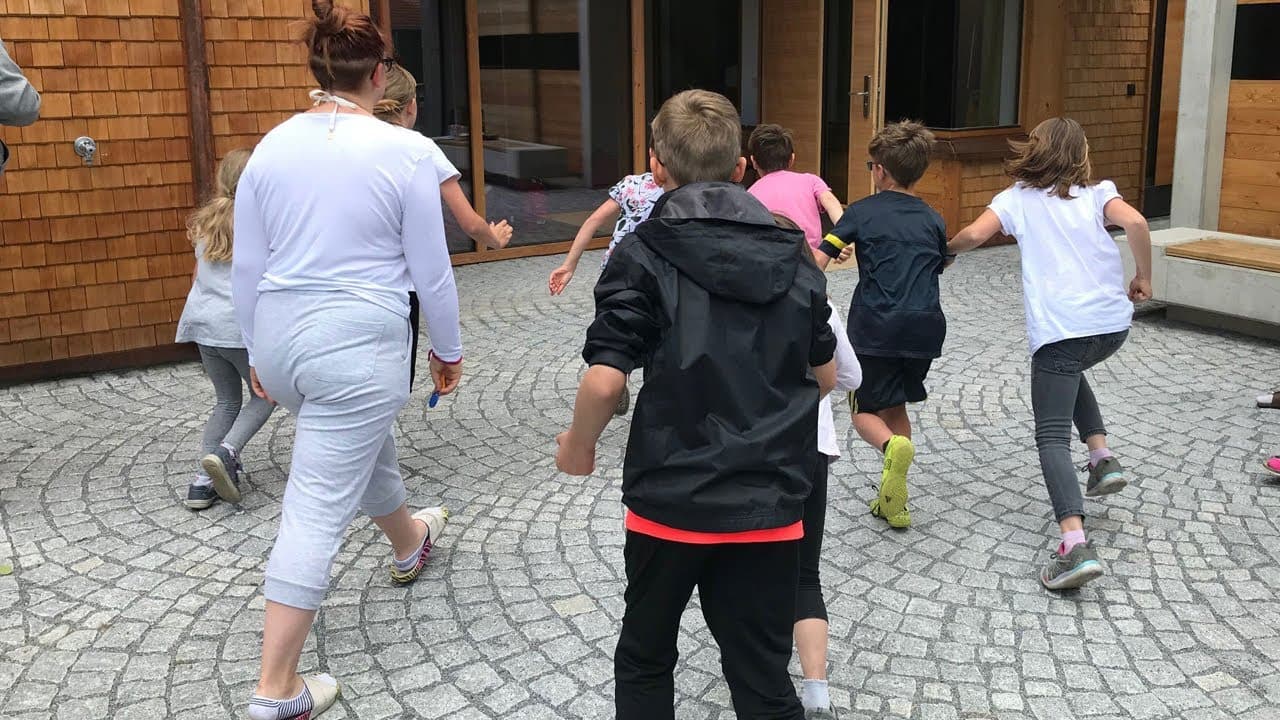
Visit at the first SOS Children's Village Imst
Herman Gmeiner, a medical student, saw the suffering and need of the war orphans, who, separated into girls and boys, were placed in so-called "educational institutions". He was of the opinion that these children, who had already had to cope with their war experiences and the loss of their parents, were better off growing up in a village community, with a village mother and their biological siblings.
So in April 1949 he laid the foundation stone for the first Children's Village House. A small village with a total of 21 houses arose above Imst.
After 70 years, urgent new buildings became necessary, so four dilapidated houses were demolished and two larger houses for 9 children each were built instead. We talked with Raffaela and Viktor, two young and very motivated social pedagogues. They are responsible for the children in one of the new buildings. Their team looks after these 9 children between 7-15 years 24/7.

Dear Raffaela, dear Viktor, how does your everyday life here in the SOS Children's Village look like?Raffaela: We are responsible for the children as a team and there is always someone here, 365 days a year. We maintain a "normal" daily routine, try to give the children structure and take care of everything that parents would do for their children. We cook and eat together, play, help with homework, go sledding in winter or do handicrafts. Many children do not know such structures from their past, these are very important for them, they give them security.We also have a cat and chickens, the children are responsible for cleaning out the henhouse and fetching eggs. This is a lot of fun for them. They are happy to have a job.
Why do these children come to the SOS Children's Village?Viktor: We accept children who can no longer live at home for reasons such as neglect, physical or sexual violence, drug addiction or excessive demands on their parents. The children are assigned to us by the social welfare office. Usually the situation is already very serious when a child is brought to the SOS Children's Village. It is all about protecting these children, giving them support, warmth and a home. They should have a childhood worthy of the name.
Do these children have contact with their biological parents?Raffaela: The children often long to be able to live with their mom and dad again, no matter what has happened at home - mostly during many years. Therefore it is very important to be in constant contact with the family of origin. Depending on their history and circumstances, parents can also visit their children or vice versa. However, the top priority is to protect these children from further abuse.
The goal is to find solutions with the parents and to work with them so that they are able to take care of the children again at some point. We often succeed in this, but sometimes this is unfortunately not possible.
How long do these children live in the SOS Children's Village?Viktor: There are children who came here as babies and will probably stay here until they are grown up. Other children are here for 3-4 years. It always depends on the individual family circumstances.
We have integrated a one-room apartment in the new building here for young people over 18, so they can take their first steps towards independence, but we are always there for them, just as their parents would be.
What is your biggest challenge?Raffaela: To respond to the individual needs of the children. Each child is different, each needs something different. It is often not easy to recognize this.
What is your greatest joy?Viktor: Seeing a child blossom, laugh and play again. Raphaela: Yes, the most beautiful thing is to see how children can trust us and be whole children again.
A loan was taken out for the construction of the two new houses. Thanks to numerous donors the nearly 3 million EUR could almost be covered. EUR 100'000 are still missing to cover the construction costs completely. If you would also like to make a contribution, we would be delighted!